Introduction
For every academic journal, visibility is essential. Publishing high-quality research is only one part of the journey—the next step is ensuring that researchers, scholars, and institutions can easily discover your journal. This is where journal indexing becomes invaluable.
Scientindex is an excellent opportunity to get your journal noticed around the world. A global multi-disciplinary academic publishing database, Scientindex helps journals be found and reach a larger academic community.
Many publishers are looking to get the journals indexed quickest, but it is important to remember that this should not be at the cost of quality. The better prepared that a well written Journal is that the better chance that it will go through the evaluation process in a timely fashion.
In this guide, you'll learn how to get your journal ready for indexing in Scientindex and how you can maximize its efficiency in the process.
Why Journal Indexing Matters?
Journal indexing isn't merely a process of adding your publication to a database. It increases the visibility of your journal, boosts your academic profile and makes published research readily accessible for researchers.
Some of the key benefits of indexing include:
- Increased visibility among researchers worldwide
- Better discoverability of published articles
- Greater credibility for your journal
- More opportunities to attract quality manuscript submissions
- Improved accessibility for institutions and libraries
- Stronger academic presence in the research community
Indexing is an important milestone for journals that want to expand to the international level.
Is There a Fast Way to Get Indexed in Scientindex?
The answer is yes, but preparation is key.
An existing journal that adheres to good practice is generally more easily judged than one that lacks information or a lack of consistency.
Publishers should be working towards making their journal ready for review rather than seeking a shortcut. Full documentation, clear editorial guidelines, and a professional website can considerably cut down on delays throughout the evaluation procedure.
Steps to Speed Up the Scientindex Indexing Process
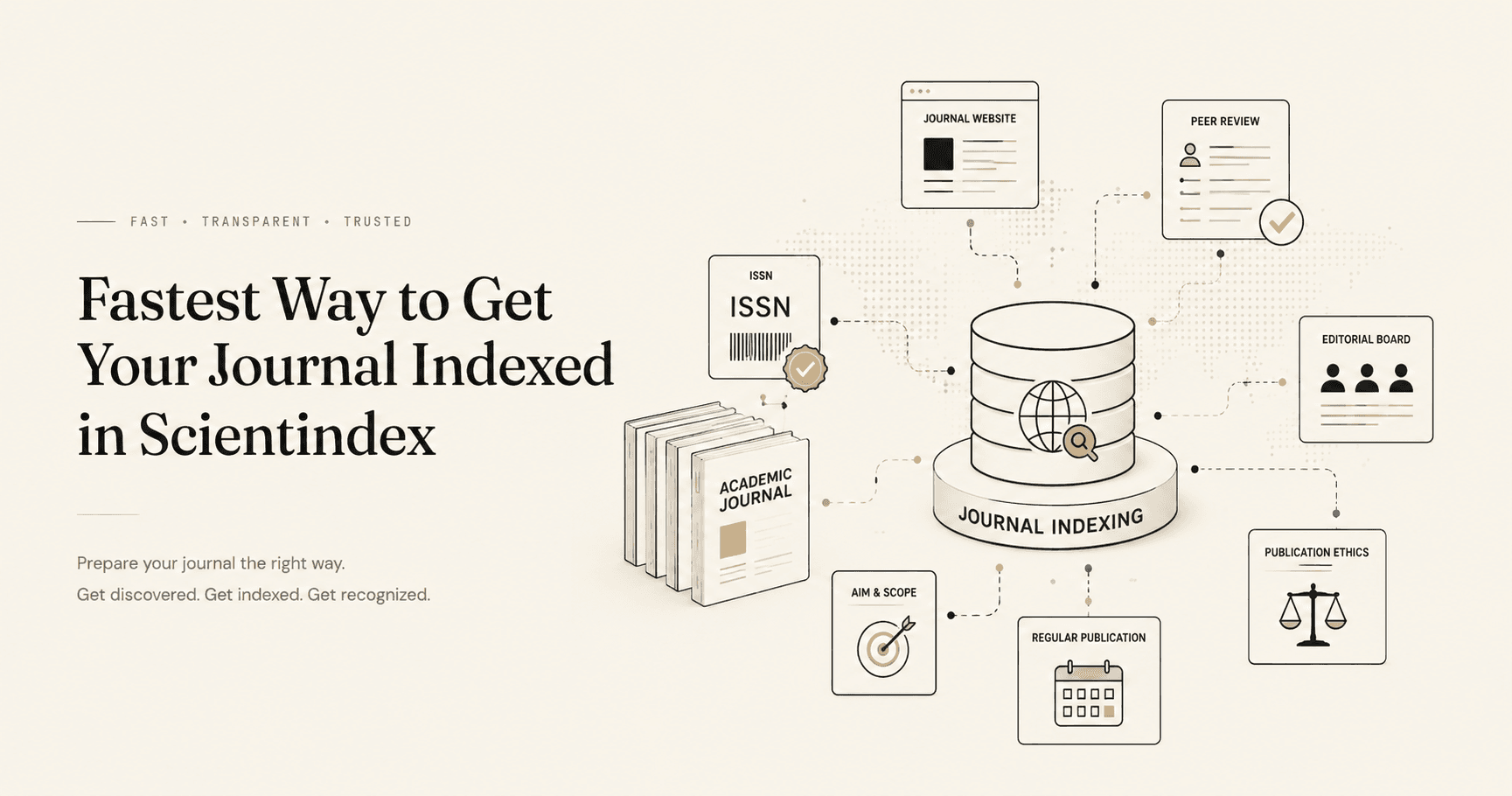
1. Maintain a Professional Journal Website
It is important that your journal website contain everything that the authors and researchers expect to see.
Include pages such as:
- About the Journal
- Aim and Scope
- Editorial Board
- Peer Review Process
- Publication Ethics
- Author Guidelines
- Contact Information
- Current and Archived Issues
Your journal is assessed by the reviewers efficiently by a complete website.
2. Publish Regularly
Consistency is one of the most important indicators of a reliable journal.
If you have a monthly, quarterly, biannual or annual publication schedule, be sure to publish on time each issue!
An irregular period of publications may delay the evaluation process.
3. Follow a Transparent Peer Review Process
Having a well-established peer review process shows your dedication to quality academic work.
Explain:
- How manuscripts are reviewed
- Review timelines
- Reviewer responsibilities
- Editorial decision process
The more transparent you can keep your journal, the more confidence you'll gain in it.
4. Strengthen Your Editorial Board
A good editorial board is one of the best indicators of a good journal.
Invite experienced academicians and experts on the subject from reputed institutions.
Make it easy for your visitors to find out about your affiliations and profiles in your website.
5. Follow Publication Ethics
Scientindex strives to publish journals with high ethical standards.
Your journal should have policies on:
- Plagiarism
- Authorship
- Conflict of Interest
- Data Integrity
- Corrections and Retractions
- Copyright
Good ethical practices demonstrate the credibility of your publication.
6. Keep Journal Information Updated
Check to ensure that journal information is up to date prior to applying.
Check:
- ISSN details
- Publisher information
- Editorial contacts
- Website links
- Publication frequency
- Archive pages
The accuracy of information helps to avoid unnecessary delays in the evaluation process.
Scientindex Journal Readiness Checklist
|
Requirement |
Recommended Status
Before Applying |
|
Professional
journal website |
✔ Complete |
|
Valid ISSN (Print
and/or Online) |
✔ Available |
|
Peer review policy |
✔ Published |
|
Editorial board
information |
✔ Updated |
|
Publication ethics
page |
✔ Available |
|
Regular publication
schedule |
✔ Maintained |
|
Author guidelines |
✔ Published |
|
Aim and Scope |
✔ Clearly Defined |
|
Contact information |
✔ Verified |
|
Archive of
published issues |
✔ Accessible |
Common Mistakes That Delay Journal Indexing
There are a lot of journals that have delays due to avoidable issues.
Some of the most prevalent are:
- Incomplete journal website
- Missing editorial policies
- Irregular publication schedule
- Limited information about the editorial board
- Broken website links
- Missing publication ethics statement
- Poor manuscript formatting
- Inconsistent journal metadata
It is important to carefully analyze your journal prior to submission to prevent these issues.
How Scientindex Evaluates Journals?
All journals for Scientindex are quality checked to fulfill the academic publishing standards of the platform.
The assessment can take into account the following:
- Editorial quality
- Website structure and transparency
- Peer review practices
- Publication consistency
- Academic relevance
- Ethical publishing standards
- Accessibility of journal content
It's often easier to assess a well-structured journal that contains enough information.
Why Choose Scientindex?
Scientindex is a worldwide database for multidisciplinary academic publishing that supports journals across a broad range of academic disciplines.
By indexing your journal in Scientindex, you can:
- Improve your journal's international visibility.
- Make published articles easier to discover.
- Reach researchers, scholars, and institutions worldwide.
- Strengthen your journal's academic presence.
- Contribute to the global exchange of scholarly knowledge.
Scientindex is a platform to extend the reach and recognition of your journal whether it is science or medicine, engineering or management, education or social sciences or the humanities.
Tips for a Successful Scientindex Application
To increase the probability of a good evaluation:
- Ensure your website is complete and professionally maintained.
- Publish issues consistently according to your schedule.
- Clearly explain your peer review process.
- Maintain a qualified and active editorial board.
- Follow internationally accepted publication ethics.
- Keep all journal details accurate and up to date.
- Check that all website links are functional before submitting your application.
- Review your published articles for consistency in formatting and metadata.
These steps taken in advance will save time, and facilitate a more efficient review process.
Conclusion
There is no shortcut to quality journal indexing, but there are certainly ways to make the process faster and smoother. The fastest way to get your journal indexed in Scientindex is to ensure that it is fully prepared before submitting your application.
The more efficient the evaluation process, the more professional the website, the clearer the editorial policies, and the more consistent people publish. The better the website is, the more clear the editorial policies, the more consistent people publish, and the more professional the evaluation process is. In investing in these areas, publishers can maximise their chances of achieving a successful indexing result.
Scientindex is a global database for academic publication of quality journals across multiple disciplines and is dedicated to increase the visibility of academic research in the world.
Considering your journal is prepared to meet the publishing standards, submitting to Scientindex indexing can be an important move towards growing the reach and impact of your academic research.
Frequently Asked Questions
1. What is Scientindex, and why is it important for academic journals?
Scientindex is a global multidisciplinary academic publishing database that helps journals improve their visibility, increase discoverability, and reach researchers, scholars, and institutions worldwide. Being indexed can strengthen a journal's academic presence and credibility.
2. What are the basic requirements for getting a journal indexed in Scientindex?
Before applying, a journal should have a professional website, a valid ISSN, a published peer review policy, an updated editorial board, publication ethics, author guidelines, a regular publication schedule, clearly defined aims and scope, verified contact information, and accessible archived issues.
3. How can I improve my journal's chances of being indexed in Scientindex?
You can improve your chances by maintaining a professional journal website, publishing issues consistently, following a transparent peer review process, strengthening your editorial board, adhering to publication ethics, and keeping all journal information accurate and up to date.
4. What common mistakes can delay the Scientindex indexing process?
Common reasons for delays include an incomplete journal website, missing editorial policies, irregular publication schedules, limited editorial board information, broken website links, missing publication ethics statements, poor manuscript formatting, and inconsistent journal metadata.
5. How does Scientindex evaluate journals for indexing?
Scientindex evaluates journals based on several factors, including editorial quality, website structure and transparency, peer review practices, publication consistency, academic relevance, ethical publishing standards, and the accessibility of journal content.